Grades K-8
Small gaps
don't stay small.
A shaky grip on fractions in fourth grade is a bad afternoon. The same gap in ninth grade is a failed course and a tutor nobody budgeted for. These are the years when fixing it is still cheap.
Start free — no cardWhy this is the cheap end
Everything in school is built on something earlier. Place value holds up long division; fractions hold up ratios; ratios hold up algebra. When one of those is shaky the work above it gets harder for reasons nobody can point at — which is why the problem usually surfaces years after it started, wearing the name of a different subject.
By then it is expensive. A high-schooler needs the missing thing AND the current thing, usually under exam pressure, usually paying somebody. The same gap at eight takes a few short sessions, because there is less built on top of it and no deadline attached.
That idea is the whole name. LeftStart comes from an engineering habit — move the fix as far left on the timeline as it will go, because the cost of a problem grows the longer it rides. Where the name came from
Twenty minutes, most days
Not an hour on Sunday. The short-and-often version is not a compromise for busy families — it is the one that works better, and it is how the app is built underneath.
Being asked beats reading again
Having to produce an answer is what moves a skill. Reading the page a second time builds the feeling of knowing it, which is a different thing and does not survive contact with a test.
Spaced beats crammed
Mastery fades here on purpose, so a skill comes back round before it is gone. That is why little-and-often adds up and a weekend blitz mostly does not.
It aims at what is actually weak
Practice targets the lowest skills rather than whatever came next in a book. Twenty minutes pointed at the right thing beats an hour spread evenly over things they already have.
A short session is a session that happens
The plan that survives a Tuesday is the one that fits between dinner and bed. There is a streak counter and it is deliberately quiet — it hides itself at zero, and one missed day a week is forgiven. Nothing here will message you to protect it.
The step-by-step of how a session runs lives on how it works — this page is about why it is worth doing now.
What a nine-year-old actually sees
Not a report card. Her screens are about what is getting stronger, and the word “wrong” does not appear on either of them.
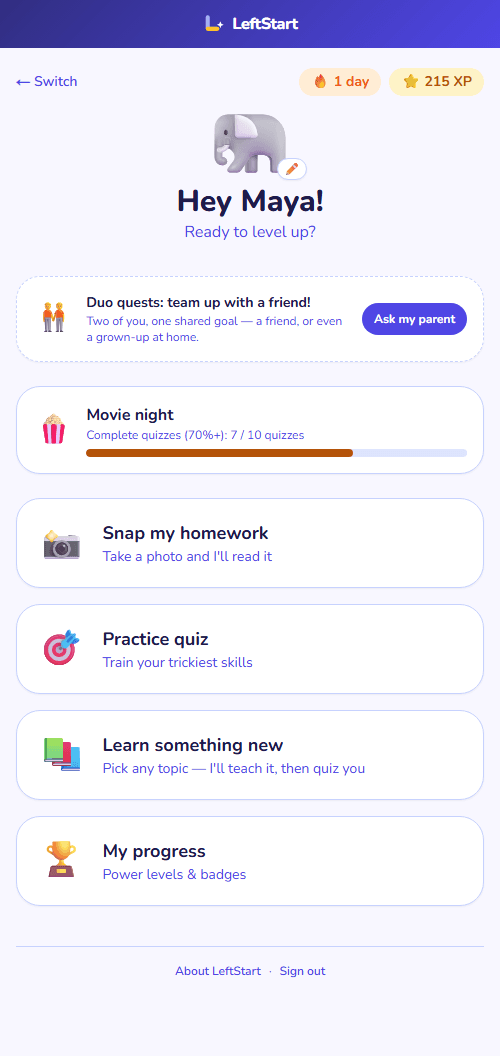
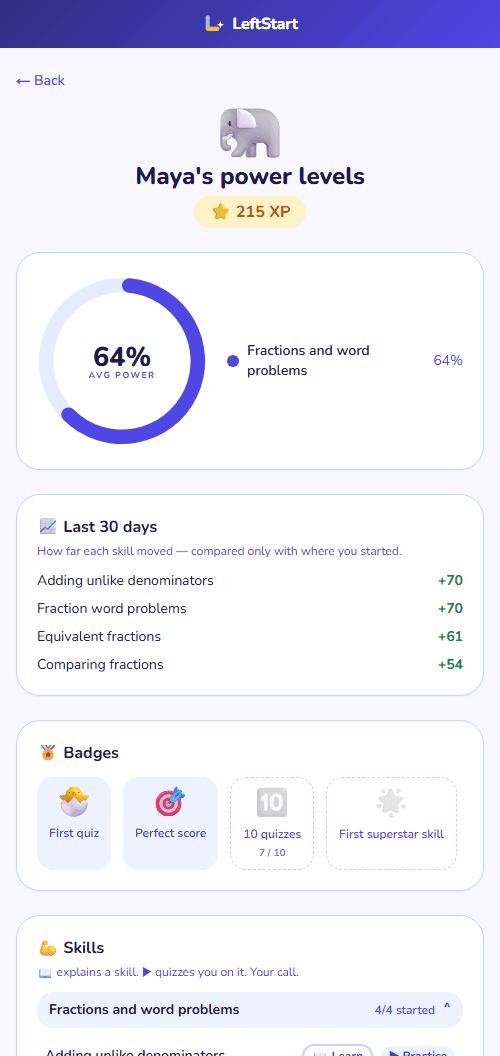
Those are the real app, photographed from a demo profile — not mock-ups, and not a real child. The list in the middle of the second one is the part worth looking at: it shows how far each skill moved compared with where she started, which is a number a child can beat. Her rank against anybody else is not shown, because it is not collected.
A six-year-old and a thirteen-year-old are not the same customer
K-8 is a nine-year span, so the app does not use one voice across it. Up to fifth grade it is playful — emoji levels, lots of celebration, every question readable aloud with one tap for a child still working on reading. From sixth it shifts to adventure: same engine, plainer language, fewer stickers, because nothing kills a twelve-year-old's interest faster than being handled like a toddler.
It picks by grade without being asked, and a parent can override it from the dashboard — some ten-year-olds want the plain version, and some thirteen-year-olds really do not.
Siblings are never ranked against each other
Family quests are a shared goal the whole house wins together, and that is the only family-wide number there is. We looked hard at leaderboards and turned them down: in a family of three, somebody is permanently last, and the child who most needs the practice is the one most likely to stop.
A child's progress is compared with where that child started. Nowhere else.
And it is free, permanently
No subscription, no trial that ends, no ads, and nothing sold to anybody. It is run as a nonprofit project so that the years that matter most are not the ones priced out of reach — though not yet as a registered 501(c)(3), and the donate page explains exactly where that stands.
Why it's free →Twenty minutes tonight is worth a term of catching up later.
Start free — no cardNo subscription, no ads, nothing to cancel.
Know a family with a kid in primary school?
Older learner? See every learner stage